(NaturalNews) Why are genetically modified organisms (GMOs) a serious threat to humanity and the environment? The reasons span the realms of science, social justice, economics and the environment, and once you understand this, you'll readily understand why so many environmentalists, humanitarians, responsible scientists and social justice advocates are strongly opposed to GMOs.
Here are the top 10 ways GMOs threaten us all:
#1) Every grain of GM corn contains poison
GM corn is genetically engineered to develop a deadly pesticide in every grain of corn. When this corn is harvested and turned into Corn Flakes, corn tortillas, corn syrup or other corn-based foods, that same poison remains in the corn.What is the effect of human children eating all the poisons grown in GM corn? Nobody knows for sure because the tests haven't been conducted on human consumption. That's why GMOs remain an untested experiment that exploits humans as guinea pigs.
See www.GMOevidence.com to learn more.
#2) GMOs have never been safety tested for human consumption
Although GMO advocates ridiculously claim GMOs have been "proven safe in thousands of studies," what they don't tell you is that those were all short-term studies on animals, not humans.In fact, GMOs have never been shown to be safe for long-term human consumption. What happens when a child eats GMOs for two decades? Does it substantially increase their risk of cancer, diabetes, kidney failure or future Alzheimer's? Nobody knows, exactly, because the tests haven't been done.
As often happens with other chemicals, GMOs are simply let loose into the world with an attitude of "let's see what happens!"
See: www.GMOseralini.org to learn more.
#3) GMOs transform farming freedom into farming servitude
Because GMOs are sold with an intellectual property restriction that prevents farmers from saving their own seeds, they invoke "economic servitude" where farmers are forced to buy expensive new seeds each year from the GMO seed supplier.As a result, farming practices (like seed saving) that have sustained humanity since the dawn of civilization are now being criminalized. And when GM crops fail, as they frequently do, the economic burden placed upon farmers is often too much to bear. That's why farmer suicides have skyrocketed in India among farmers who bought GMO seeds.
Reportedly, over 270,000 suicides have already happened in India due to crop failures, and more happen every day.
Learn more from the GMO Myths and Truths report.
#4) GMOs run the very real risk of runaway self-replicating genetic pollution and ecocide
Unlike isolated chemicals, GMOs self-replicate. This means there is an automatic risk of a runaway ecological holocaust caused by genetic pollution from GMOs.Once scientist calls this risk "ecocide" and has calculated the risk of ecocide caused by GMOs will approach 100%. As I wrote in this March 2014 article:
As Taleb convincingly argues, genetically engineered crops are specifically designed to have a survival advantage over conventional crops, allowing them to better resist droughts or infestations of pests or weeds. This survival advantage -- if it's as real as seed manipulators claim -- means genetically engineered plants can out-compete non-GMO crops in open fields. The genetic pollution which is already underway across North America will only get worse, therefore, and there's no reversing it because all living systems -- even genetically engineered ones -- have a natural drive to spread, multiply and survive.
The result is that GMO crops will out-compete and thereby displace non-GMO crops over time. Why does this matter? Because the rise of GMOs is nearly synonymous with the collapse of genetic diversity in seeds and food crops.
#5) GMO agriculture is breeding a new generation of chemical-resistant superweeds
The rise of chemical-resistant superweeds is a horrible problem for modern farmers. In the same way that deadly superbugs have arisen from the abuse of antibiotics in hospitals, "Frankenweeds" have arisen from the continued growing of GMOs and the routine application of glyphosate to crop fields.Glyphosate-resistant superweeds have become such a problem that the very industry which once claimed GMOs would require "fewer chemicals" to grow food is now recommending fields be treated with a triple or quadruple layer of multiple chemicals to attack the superweeds with different chemicals.
That's why agriculture experts are right now sounding the alarm over glyphosate, GMOs and superweeds, calling for an end to the unsustainable GMO farming practices that seriously threaten the sustainability of agriculture.
See www.naturalnews.com/superweeds.html
#6) GMOs may have long-term unintended consequences on the environment
What happens when genetically engineered plants cross-pollinate with non-GMO plants and are then subjected to the random mutations of plant evolution?No one knows because it's never been tested in the open world. Or, I should say, it's being tested right now on us all, in the world's largest genetic experiment ever conducted (without our consent, no less).
The problem in all this is that Mother Nature has a way of bringing about unintended consequences, even from well-meaning scientists. Is it possible that an artificial, genetically engineered trait could dominate future plant generations but begin to show a completely unintended physiological trait that scientists never intended? You bet it is. From Thalidomide to Fukushima, the world is full of examples of catastrophic consequences that scientists once swore could never happen.
Famous last words: "What could possibly go wrong?"
#7) GMOs collapse biodiversity
In an effort to monopolize the global seed supply, GMO companies are buying up smaller seed companies and shutting them down, collapsing their seed supplies. The following chart shows some of the seed consolidation activity that's concentrating ownership over seeds into the hands of a very small number of powerful, unethical corporations:(Click image to view full-sized chart.)
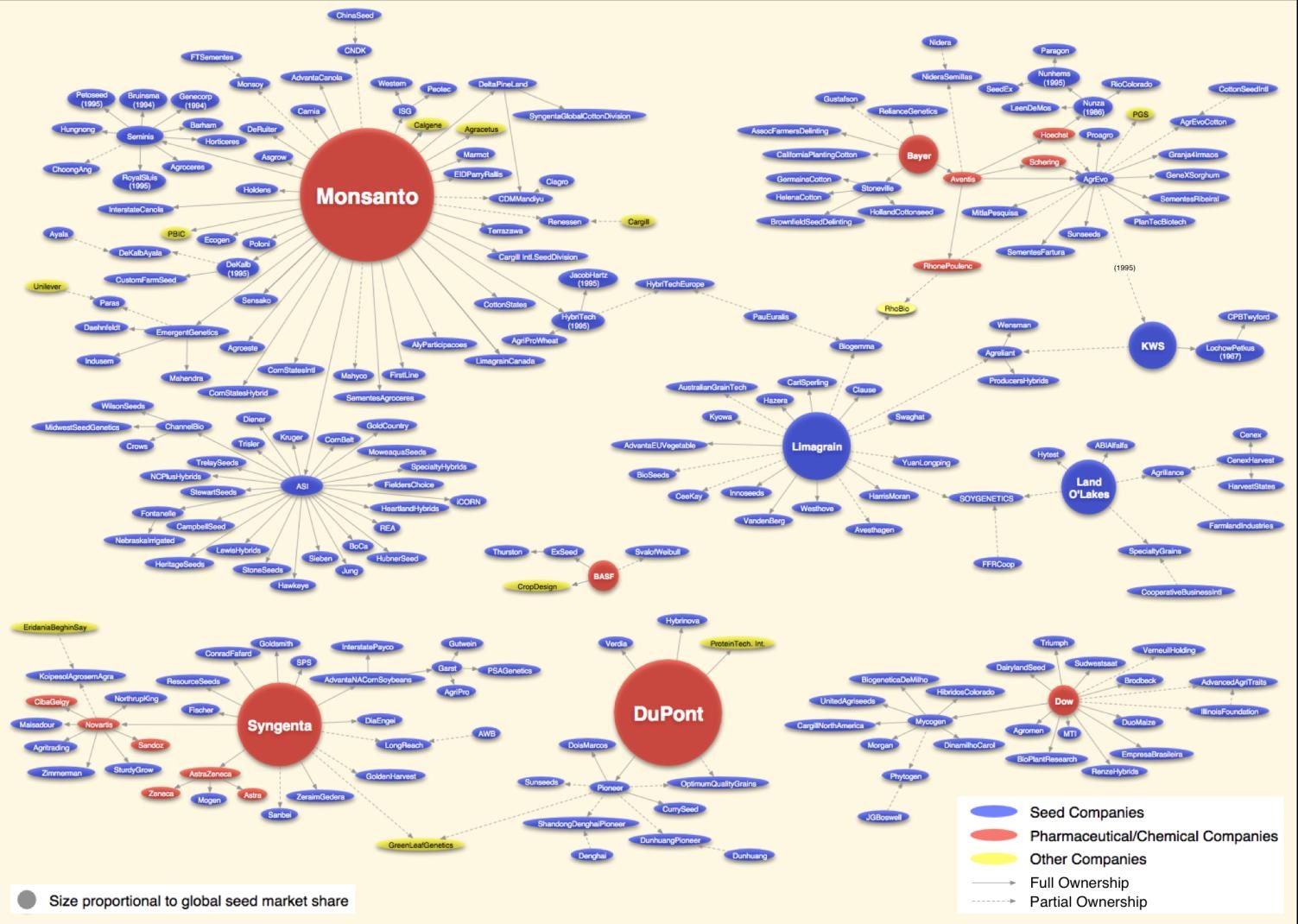
This consolidation of seed companies has caused an alarming collapse in seed diversity over the last decade, placing humanity at increased risk for catastrophic crop failures due to a loss of genetic diversity.
That's the problem with genetic conformity: it makes the crops far more susceptible to systemic diseases that can cause catastrophic crop failures. Precisely this scenario is happening right now with banana crops, as most commercial banana trees are genetically identical clones.
As a result, a fungus has attacked banana crops and is causing devastating destruction across the banana industry. The industry is responding by -- guess what? -- foolishly turning to genetically engineered bananas which will suffer from the exact same weakness of genetic conformity, practically guaranteeing a future disease epidemic.
#8) GMOs put control over the food supply into the hands of profit-driven corporations
Before corporate agriculture, food production used to be under the control of local farmers who cared for their families and communities. But now, food seeds are monopolized by greed-driven corporations that care nothing about families or communities (but worship profit at all costs).It almost goes without saying that these corporations make decisions in the best interests of their shareholders, not the best interests of humanity or the environment.
Expecting corporations to place the long-term sustainability of life on Earth as a higher priority than their own quarterly profits is a form of insanity. Corporations only exist to maximize short-term profits, regardless of the long-term cost to humanity or the planet.
#9) GMOs may be harming pollinators
Although the evidence on this isn't yet conclusive, GMOs may be contributing to the harming of all-important pollinators, without which we would all starve from lack of food crops.Honeybee pollinators are dying in record numbers across North America, and many scientists fear we may be witnessing a catastrophic collapse of pollinator populations. Evidence is already emerging that neonicotinoids -- a class of pesticide chemicals -- may be responsible for the collapse, but there's also evidence that GMOs may be worsening the population decline.
Were GMOs ever tested for their long-term impact on pollinators in the wild? Of course not. That would cost too much money, and the promotion of GMOs is all about making money; the environment be damned.
"If the bee disappeared off the surface of the globe, then man would have only four years of life left. No more bees, no more pollination, no more plants, no more animals, no more man." - Albert Einstein
#10) The kind of scientists who collaborate with biotech companies are the most dishonest, corrupt and unethical scientists in our world
The world of science consists primarily of ethical, reasonable people who are doing their best to contribute to knowledge and progress for our world. But the darkest "fringe" fanatics of bad science are found in the realm of GMOs, where scientists routinely accept money from the biotech industry to lie to the public and attack "GMO skeptics" -- people who are skeptical about the false promises made by biotech corporations.Biotech-linked scientists and journalists are the most nefarious and evil-minded of their kind, waging vicious smear campaigns against environmentalists while working desperately to block the public's right to know what they're eating. "Biotech shills" have been a key part of the defeat of GMO labeling laws in California and Oregon, for example, where their message has been, "Make sure the public NEVER knows they're eating GMOs!"
In every way imaginable, the scientists and journalist who blindly push GMOs are a great disservice to the scientific community and will only discredit science in the long run as the long-term harm caused by GMOs becomes undeniable.
REAL science allows for skeptical questions and embraces the precautionary principle, but quack "GMO science" abandons precaution while disparaging anyone who poses reasonable questions about playing God with nature.
The blind leading the blind
GMO shills, of course, dismiss all these concerns (or hope you don't notice them). Their foolish strategy is to cover their eyes, cover their ears and march humanity down this path of destruction, all while hoping to cash in on quarterly profit dividends in the mean time.There is no rational justification for putting the entire world at risk with genetically engineered crops that have clearly failed to be subjected to responsible long-term scientific testing. As with most other chemicals -- aspartame, Agent Orange, Bisphenol-A and so on -- industry simply unleashes them onto the world and hopes nothing goes wrong.
But Murphy's Law tells us bad things can happen even when you don't want them to, and with GMOs, we're now playing with self-replicating organisms rather than mere chemicals. GMO-based agriculture is a Pandora's Box which can never be closed once opened.
While I do believe GMOs might one day be developed and deployed in a safe and cautious manner, today there is presently zero willingness on the part of biotech corporations to expend the kind of time, money and resources required to establish such safety. There is also zero willingness in the minds of GMO-fronting scientists to even consider the possibility that they might be wrong. One such GMO front man named Jon Entine has even written a book with one of the most disturbingly arrogant titles imaginable: "Let them Eat Precaution."
And so, in a very real sense, we are all playing Russian Roulette with our collective future, hoping against all odds that the shortcut scientists working for companies like Monsanto have already thought of everything.
History tells us such hope is deeply misplaced.
Learn more about GMOs:
www.ResponsibleTechnology.org
www.OrganicConsumers.org
www.GMwatch.org
http://gmomythsandtruths.earthopensource.org


