LE BLOGUE DES EXERCICES,DU CONDITIONNEMENT PHYSIQUE ET DE L'ALIMENTATION-DE L'HYGIENE DE VIE/EXERCISES-CONDITIONING AND PROPER FOOD DIET BLOG.
SOYEZ LES BIENVENU(E)S-YOU ARE WELCOME
Tout dans la vie est une question d'équilibre d'où la nécessité de garder un esprit sain dans un corps sain.
Discipline-Volonté-Persévérance
Everything in life is a matter of balance therefore one needs to keep a healthy mind in a healthy body.
The Lazy Man’s Guide
People like the bare minimum. Instinctively we want to know what’s the least we
can do to get a result. Yes there are some that would say “if one ibuprofen is good, then 10 must be better” but those are the same people that end up with liver problems. It could be laziness, but it’s more than likely intelligence.
Training is no different, we should strive for the minimum effective dose, when delivering it to our athletes or to ourselves. Becoming great at a skill like Olympic weightlifting is a different beast, but for most that is not an issue until after we have tried out the minimum effective dose.
This is the bare minimum Olympic weightlifting program you should be doing to be a good Olympic lifter.
Combos to start
Start here. Use combos to get used to real Olympic weightlifting. Combos ease the transition to the full lift.
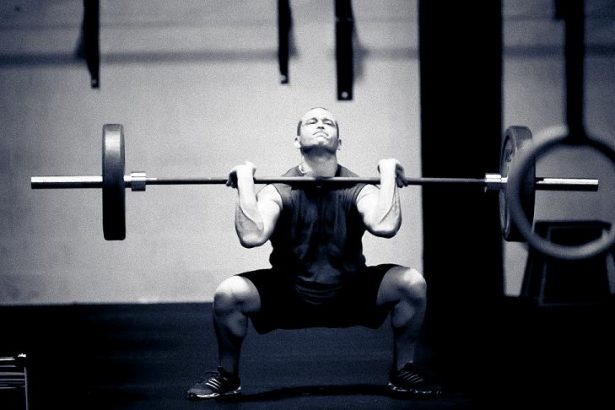
For the clean use a power clean + front squat and a jerk (power or split depending on your comfort). Get used to pulling under the bar and catching at a lower height to move to the full clean.
For the snatch do a similar movement, power snatch + overhead squat. Start pulling under the bar and eliminating the pause before going into an overhead squat.
The Real Thing (or a variation)
To be effective at the Olympic lifts you have to use the real movement. Even if you have every intention of power cleaning for the rest of your life, take some time to get good at catching in the deep squat position.
Once you are comfortable at the real movement, choose a variation that is the right one for you, or your athletes. This means one that will get your athletes the greatest benefit, or yield the biggest returns for yourself.
For most field sport athletes: use the hang power clean
For sprinters in track: use the power clean
For tall athletes: Use a dead start on the blocks
For times where hypertrophy is needed: Use the full movement to grow some massive quads.
I recommend some time spent doing the full movement because the full movement is the purest expression of technique. You can’t do the full movement while catching the bar in the starfish position, you can’t do the full movement without great mobility.
These technical details will then carry over to whatever variation you choose for your main movement.
LOTS of squatting
A wise man once said “squatting helps everything.” Since I am referring to this man as wise, lets go ahead and assume that I agree with him.
It’s true. If you want to be better at the Olympic lifts squatting is the life blood of champions.
The crazy thing is, even if you aren’t doing the full lifts (floor start, A2G catch), squatting still helps. One of my elite pole vaulter’s does the hang clean exclusively but she was missing all of her lifts at the receiving position. Slightly forward catch and dumping the weight anytime she got heavy.
The solution was simple she had to squat more. After adding 20k to her front squat, and with no technical changes to her clean, she made every clean she attempted.
I do have some bad news for you. You have to be able to squat deep for their to be carry over. Power lifting squats just don’t work for Olympic lifting improvement. Olympic lifting squats need to be front squats or high bar, narrow stance back squats.
Like these (this is Clarence Kennedy a European Jr. lifter, he’s good)
Some pulls
Plenty of people argue against pulls as part of the training program. The typical objection is that they teach people to extend up too much rather than move under the bar (I am in favor of them, they are my plateau busters).
Pulls shouldn’t make up all of your program, but including them periodically will go a long way to making your O lifts improve.
Remember the snatch grip deadlift and clean grip deadlift are pulls as well, just approach the lift like you are moving the bar from the ground for an O lift and not a normal deadlift (Like this).
The Lazy Olympic Weightlifting Program
The bare minimum Olympic weightlifting program could look as simple as what is below.
Two movements per day.
This is designed to be something that you could do while also doing all the curls, bench press, and leg presses you want.
Week 1: Day 1
Exercise
Set
Reps
Power Snatch + OH Squat
4
(1+1)x3
Front Squat
4
4
Week 1: Day 2
Exercise
Set
Reps
Power Clean + Front Squat+Jerk
4
(1+1+1)x3
Clean Deadlift
4
4
Week 2: Day 1
Exercise
Set
Reps
Power Snatch + OH Squat
5
(1+1)x2
Back Squat
5
4
Week 2: Day 2
Exercise
Set
Reps
Power Clean + Front Squat + Jerk
5
(1+1+1)x2
Snatch Pull (or from deficit)
5
3
Week 3: Day 1
Exercise
Set
Reps
Snatch
4
3
Front Squat
4
3
Week 3: Day 2
Exercise
Set
Reps
Clean and Jerk
4
3+2 (1+1 style)
Back Squat
4
3
Week 4: Day 1
Exercise
Set
Reps
Snatch
5
2
Snatch Deadlift (or from Deficit)
5
3
Week 4: Day 2
Exercise
Set
Reps
Clean and Jerk
4
2+1 (1+1 style)
Front Squat
4
2
*On combos (including clean and jerk) the first number is for the first movement, the second number is for the second movement.
**Loading should be done with the greatest amount of weight that one can handle for each prescribed set.
***This program can be repeated, replacing the combos to start the training program with full movements or your chosen variation
Conclusion
Getting better with the Olympic lifts does not mean that one has to spend hours upon hours on the platform (becoming GREAT does). Rather, focused attention to the craft and the movements that assist the craft the most.
An athletic build is desired by many, it is similar to that of a bodybuilder but they are not the same. While a bodybuilder is built for size and strength an athletes body is built for power, speed, quickness, explosiveness and agility. Typically the body of a bodybuilder is more bulky, sometimes VERY bulky. The body of an an athlete is usually more slight. Then there is a grey area where some athletes look like bodybuilders. If you want an athletic build you need to train like an athlete does. These are the top 10 exercises athletes do to give you an athletic build.
1) Power Cleans
Power cleans and other types of cleans are a mainstay in most athletic programs. Cleans are a total body exercise that use your quads, calves, hamstrings, glutes, spinal erectors, deltoids, traps, and forearms, as well as the core muscles that come into play to stabilize your spine throughout the movement. Cleans develop power and explosiveness essential to an athlete. If an athlete could only do one exercise this would probably be it and if you can only do one exercise to achieve an athletic build this should be it as well.
2) Squats
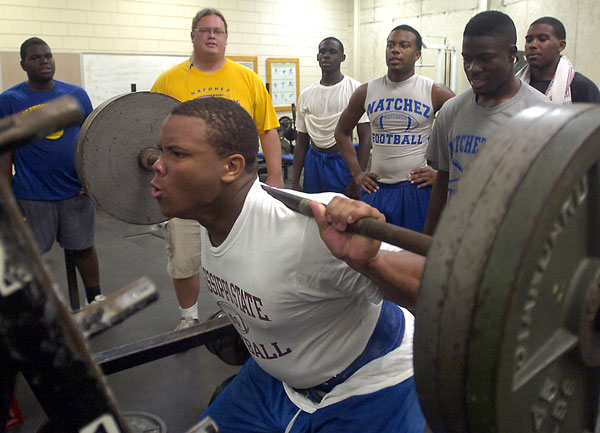
Squats are the king of the lower body exercises. Any athlete who needs power in his lower body is doing squats. Don’t be one of those people with a built upper body and chicken legs. Squats target a number of different muscle groups all over the body: the core muscles including the abdominals and lower back, the glutes, and the thigh muscles. Hit the squats hard and hit them often.
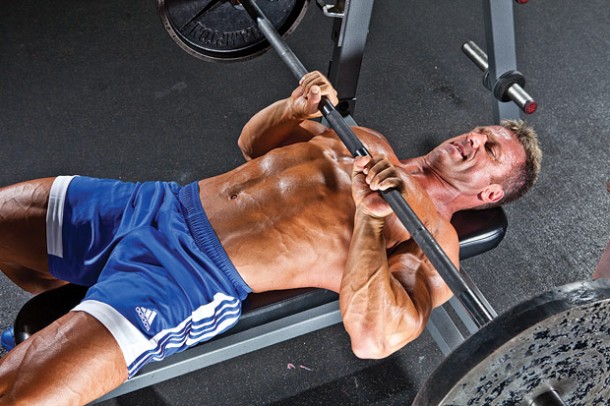
3) Bench Press
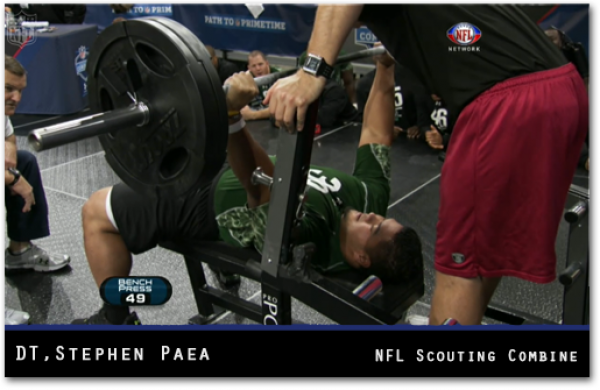
If the squats are king of the lower body the bench press is the king of the upper body. Athletes that need upper body power use this as a mainstay of their training. The bench works the chest, shoulders, triceps, and even the abs are used to help generate power and stability. Whether you do it with a barbell or dumbbells the bench press is a must.
4) Sprints
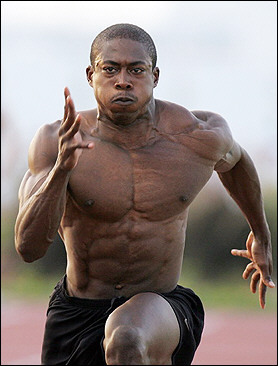
Sprints are another biggie in an athletes training, athletes not only want power and explosiveness but as the old saying goes “speed kills!” Speed can be a huge asset to to many athletes, whether it is going deep on a passing route, a fast break in basketball, or stealing second base in baseball, having speed is essential. Not only does sprinting build speed but doing sprints in interval training will burn fat like crazy which we talked about in this article. If you haven’t noticed pretty much all sprinters have athletic build.
5) Core Training
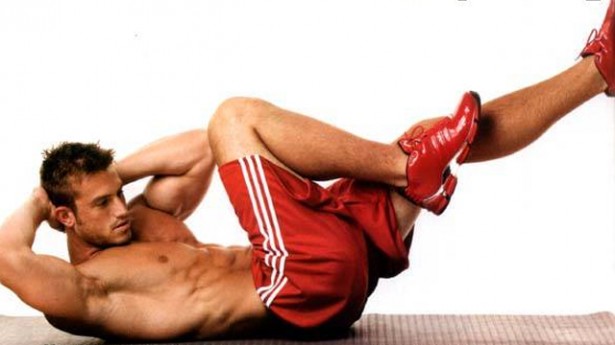
Athletes need to have a strong core and I am sure you are looking to have a six pack with your athletic build so you will need to do core training. Hanging leg raises, planks (both front and side) and crunches will get your core tight and strong.
6) Chin ups
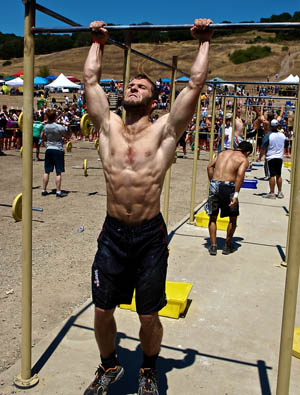
Chin ups are common exercise for many athletes as part of their training to improve pulling movements, they will also help you get that nice V-shape we all love.
7) Shoulder Press
Strong shoulders are a must in many sports for pushing movements. Shoulder presses not only work the deltoids but the triceps, lats and traps as well, they are also a must for an athletic build.
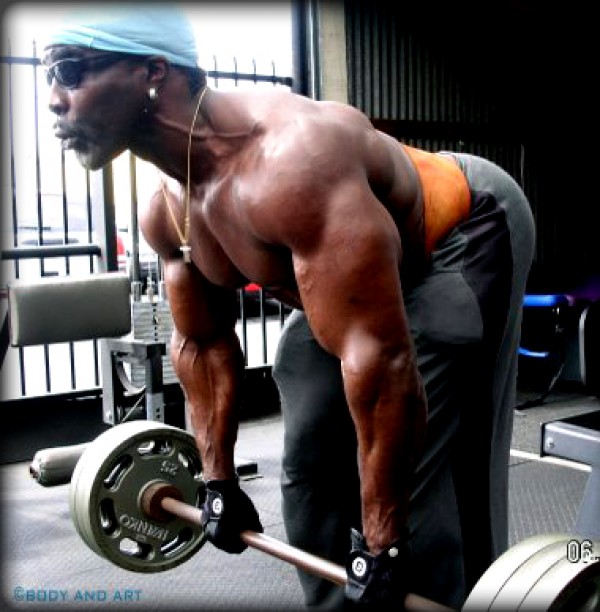
8) Rows
Rows build strength for pulling movements useful in wrestling, football and other sports. They work primarily the lats and traps as well as the biceps and shoulders. Doing rows add thickness to the back muscles.
9) Close Grip Bench Press
The close grip bench is used for athletes to strengthen pushing movements, unlike the bench press the close grip bench press focuses on the triceps as the primary muscle rather than the chest.
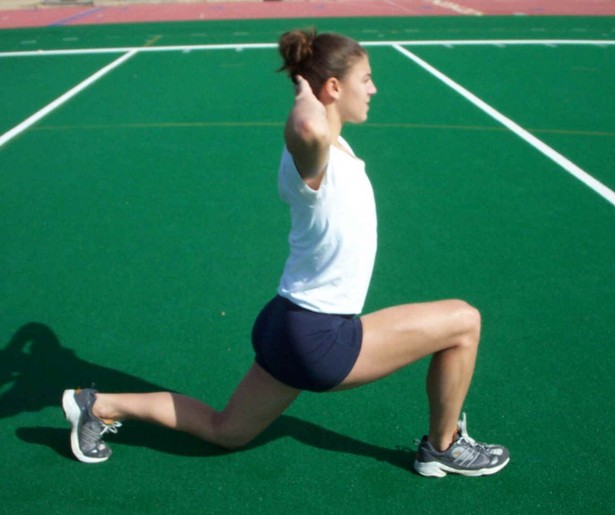
10) Lunges
Lunges are widely used to build strength in the quads, glutes and hips. They will also help you get a nice round butt we all like.
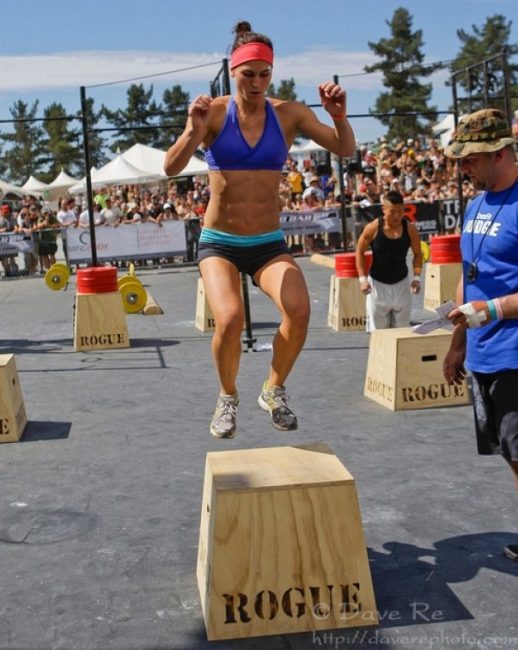
Honorable mention- Plyometrics
Plyometrics are very popular with athletes to build explosiveness, quickness and agility. They involve many different jumps and other movements. The most common type of plyometrics you see a conventional gym is usually box jumps. Use caution when doing these as they can lead to injury if you are not in good shape or do them incorrectly.
There you have the top 10 exercises you need to get you an athletic body. Notice all the exercises on the list are compound movements that use multiple muscles at the same time. Athletes generally do not do isolated movements like bicep curls or calf raises as part of their every day training, you can feel free to mix in movements like that if you desire however.
This article is an encapsulation of a teaching progression that I developed over the course of 3 years while teaching the "Olympic lifts" to over 65 Crossfit facilities in the US and Canada.
It's designed for people who are new to the Olympic lifts, and/or for those who do have some experience but still find themselves struggling. Note:Before we go further, let me state that this is designed to be a "learn by doing" article – it won't have much real value unless you watch the videos and actually try the drills I've provided in them.
With that out of the way, the goal of the following sequence of drills is rapid competence. Not mastery, not perfection, but competence.
How rapid? One session. Honestly, I'm not very patient, and I assume you aren't either. So my goal here is to get you up and running, doing decent power cleans in the very first session, so that you have a chance to taste the fun and unique satisfaction of this lift.
And trust me, it really is fun. Once you get that initial taste, my bet is that you'll then do the hard work it takes to go from competence to mastery, which, admittedly, takes a lot longer.
Since my approach is all about expedience, please excuse my choice to omit specific recommendations about breathing, grip, stance, and the "double knee bend" (whatever that is). You can worry about those details later, and/or we can hash them out in the LiveSpill.
Remember, we're after rapid competence here – like speed-reading, my job here is to help you get the gist of the story very quickly. After that, should you so choose, you can go back with an eye for more detail.
Let's Get Started
The following series of 8 drills is designed to be learned in the order presented. But before we get to the first drill, a quick word about the weights you should be using for each drill.
I obviously can't recommend specific weights, since all of you will have different strength levels. The key for each drill is that you want to select a weight heavy enough to get the proprioceptive feedback you need to facilitate learning, but not so heavy that you're forced to do "whatever it takes" to complete the drill. If you're not sure, err on the side of going too light, at least at the beginning.
Most people can successfully work their way through all 8 drills in a single session, while others may require a few sessions to digest the skills. Further, the earlier drills can usually be ditched very quickly – within a few weeks in most cases.
Wherever you happen to fall on the skill continuum, what's most important is that you learn these drills in the order they appear below, and don't be afraid to drop back a level or two if necessary.
The 8 Progressions
Drill #1: Learning The Shelf Position
The "shelf" refers to the position the bar ends up in on your shoulders at the completion of a power clean. If you're not familiar and comfortable with this position, your pull will be inhibited. So in this series of progressions, we start at "Point A" and only later will we tackle "Point B." I want you to be very comfortable with the destination before you go any further.
As you watch this video of me, you might notice some asymmetry – I have restricted flexion in my left elbow, which puts my elbows in different positions on the catch. That's okay. The main thing is that you have a pain-free, comfortable, stable position for the bar on your deltoids – not your collarbones.
Typically, most lifters will need to catch the bar with high elbows to achieve this position. Go ahead and test it for yourself: first shelve the bar with high elbows, noticing where the bar sits. Then, slowly lower your elbows – at some point, you'll feel the bar contact your collarbones, and at the same time, you'll notice (especially if you're using significant weight) the bar starting to slip off of its perch. When this happens, obviously your elbows are too low.
Be forewarned that many people will experience a significant stretch on their wrists as they practice the shelf position. Usually this fades over time, but sometimes it never does. Only time will tell.
In the meantime, taping your wrists and/or modifying the width of your grip can help a lot. Another very helpful trick is to protract your shoulders (push your elbows forward) as you receive the bar. Doing so creates a "shelf" for the bar to rest on.
Finally, keep in mind, during an actual clean, the bar only needs to be there for a moment. After that, you can drop it.
One last point on this drill: at this stage anyway, don't be concerned about having a full handgrip around the bar as it lands on your shoulders, In truth, you're better off allowing your hands to open up at this point (like mine are in the video). In the power clean, the hands become dormant once the pull has been completed (more on this later).
Okay, on to the next drill...
Drill #2: Clean Pull From Above The Knees
(By the way, even if you had trouble with the shelf, you can still move on to this next drill, since learning it doesn't depend on your ability to properly rack the bar on your shoulders.)
This drill is perhaps the most pivotal of the bunch. If you can shelve the bar properly, and if you can do this drill, you're capable of doing a great clean. It's as simple as that. Watch this video first – I'll meet you on the backside:
As you just saw, this drill very much resembles what some people call a "Romanian Deadlift," or a stiff-leg deadlift. Keeping the bar against your thighs at all times, simply sit back, allowing the bar to slide down your legs, and then, once the bar approaches your kneecaps, reverse the motion, acceleratively "jump-shrugging" the bar.
There are three main points I need to make about this drill.
First, as you sit back, get your shoulders out in front of the bar as it approaches your knees, not directly over top of it. In other words, the main body action as you lower the bar to your knees is hip flexion, not knee flexion (although it's natural and appropriate for the knees to "unlock.")
Second, it's not really a shrug. Yes, the shoulders elevate, but it's a passive elevation, not active – they elevate because your straight arms are being pushed up by the bar's upward momentum, which causes the shoulders to rise.
Third, the bar must become weightless for a split second at the top of your pull. This is one of the most significant differences between cleans and any other lift you've probably done before.
In fact, you'll notice that in the video, I have metal 5-pound plates on the bar. The only reason they're there is to provide me with auditory feedback – if you've done the pull properly, you'll hear that distinctive "ka-chink" sound on each rep. If you don't hear it, keep practicing until you do.
Before we go on to the next drill, watch this quick demonstration that I learned from coach Mike Burgener. It's something that all beginners to the clean should be shown before they start practicing the lift. The first "rep" simulates the energetics of a deadlift, and the second "rep" simulates what happens during a clean (i.e., the bar becomes weightless).
Drill #3: Clean Pull / Power Clean Complex From Above The Knees
Once you've got a consistent, relaxed clean pull going for you, the next step is to integrate it with an actual power clean. Do two clean pulls from above the knee, and on each rep, notice how the bar "wants" to travel up to your shoulders, but for now at least, you're not letting it.
On the third rep, do exactly the same thing, but this time simply allow the bar to coast up to your shoulders, and then shelve the bar once it's arrived.
The idea here is that you use the two clean pulls as a rehearsal to "groove" your power clean technique. You should understand that the pull is the active phase of the clean, and everything after the pull is the passive phase.
Here's me performing a clean with no arm contribution after the pull just to get the point across:
Drill #4: Clean Lift-Off From Floor
At this point it's time to graduate to starting your drills from the floor, which is more difficult than the above the knees position because you've got to navigate around your knees with the bar.
The first step is to learn how to start the pull in a hip-dominant manner, which is demonstrated in the video below. While this movement will look similar to a partial deadlift, the thing to notice is that the angle of my back (relative to the floor) stays constant as the bar moves from the starting position to knee height.
Most novices, however, do something different: they raise the shoulders faster than the hips, which leaves the knees flexed, which in turn reduces the power you'd otherwise have in your posterior chain.
Here's a drill to help you understand and master the idea of a hip dominant pull. Using an easy weight, do 6 reps, where the odd-numbered reps are "incorrect" (knee dominant) and the even-numbered reps are "correct" (hip dominant). Here's what that looks like:
There are three main ways to tell if you're doing this drill correctly. First, on the "correct" reps, you'll feel a lot of tension accumulate in your hamstrings. Second, you'll arrive at a position where your shoulders are in front of, not over top of the barbell as it reaches the bottom of your kneecaps. And finally, as the barbell reaches knee level, it'll want to drift forward, away from your legs, requiring you to pull it back to yourself.
On the "incorrect" reps, you won't feel much hamstring tension, and as the bar reaches your knees, your shoulders will be directly on top of the bar, not in front of it. Once this drill feels comfortable, move on to Drill #5.
Drill #5: Clean Lift-Off/Clean Pull Complex From Floor
Just like we did earlier, we're now going to use the clean pull to groove your technique for the clean. The only difference is that now we're starting from the floor as opposed to above the knees.
The only "new" technical element to absorb here is tempo – most novices will tend to quickly rip the bar right from the floor, which hurts your efficiency in a number of ways. The better approach is to pull the bar slowly until it reaches your kneecaps, and then increase the speed.
Think of it like a golf swing – club speed is important, but only at the point where it contacts the ball. Good golfers use the entire swing path to accumulate speed, and good lifters do the same thing with the bar.
Think of the tempo of a simple baseball throw: it starts slow, almost lazily slow, but then accelerates and finally snaps at the end. That's a good representation of proper bar speed on the power clean.
If this drill is coming along well, it's time to move on to the next step. If not, go back a step and brush up your technique before moving on.
Drill #6: Clean Lift-Off/Clean Pull / Power Clean Complex From Floor
This is a 3-rep drill, where each rep is a rehearsal for the next. Everything else should be self-explanatory at this point, but stay on top of the tempo issue – all 3 reps are slow from the floor to the knee. You're not strong down there anyway, so wait until you reach the "power position" before you pull the trigger!
Everything feeling good? If so, time for the next step. If not, well I guess you know the story by now.
Drill #7: Clean Pull / Power Clean Complex From Floor
All we're doing here is removing the first set of training wheels – the lift-off. If doing so doesn't seem to hurt anything, move on to the eighth and final step. If not, back down a level for now.
Drill #8: Power Clean From Floor
Congratulations! You've arrived at the final step – a power clean from the floor. I have no new technical concerns to alert you to here, since we're not really doing anything new at this point. The real trick at this stage is to spend the majority of your practice time on the level or levels that are appropriate for your current level of skill.
For most people this means clean pulls, either from above the knee (if you think you're really struggling) or from the floor (if you feel pretty good but just want to clean things up a bit).
Problem Solving
Now that we've gone through all 8 steps, let's address a handful of common issues/problems and how to solve them.
The Scoop: Complete vs. Incomplete Hip Extension
You might've noticed in the last video that my thighs make significant contact with the bar. In fact, all competent weightlifters demonstrate this maneuver. Less skilled lifters, by comparison, do not.
Most coaches think it best to not teach this maneuver, as it should simply be the byproduct of good technique (i.e., complete hip extension). I'm on the fence on that issue, but I want you to do a little test to help convince yourself of how important complete hip extension is, and then I'll share a few tips to help you fully extend your hips on the power clean.
Here's the test: Perform a vertical jump (it doesn't have to be maximum effort) without fully extending your hips. (Don't do this while anyone is watching because you're going to look completely incompetent.)
Feels like shit doesn't it? I'm betting you found it difficult to pull off at all – that's how important full hip extension is on a vertical jump.
It's just as important on the power clean – not fully extending your hips hurts your clean just as much as it hurt your jump.
Now, a few tips if you're struggling with this.
First, go sloooow until the bar passes your knees. If you go too fast here, it'll be difficult to time the proper extension because by the time you push your hips forward, the bar will already be too high.
Second, get those shoulders out in front of the bar as it reaches your knees – you can't extend your hips unless you first flex them right?
Finally, it's okay if the bar isn't touching your shins (although it should still be very close to them), but by the time the bar passes your kneecaps, keep it pinned to your thighs as you pull. This helps you feel where the bar is, which in turns helps you figure out your timing for the scoop.
Here's a video I did on this maneuver a few years ago:
The Finish: The Clean Pull From Supports
Many novice lifters have trouble understanding how to "finish the pull." The drill below works absolute miracles right from the first rep. I'm really not sure why, but I think it helps the lifter feel safe enough to fully commit, since he won't be racking the bar on the shoulders, nor does he need to worry about getting it back down to the floor.
You'd think you could just do clean pulls from above the knees, but it doesn't work nearly as well.
Incidentally, in no time at all you can go really heavy with this – I routinely used to do 405 for triples when I was competing in Master's weightlifting.
The Catch: Learning How To Avoid Grinding And Crashing
Lots of new lifters struggle when it comes to racking the bar on their shoulders during power cleans. Often, they don't trust their precision and fear slamming the bar into their throat, chin, or face. The result is that they use excessive hand contribution to "guide" the bar to its proper finish position. Only problem is, you can't do this with real weight, and it also punishes your wrists and elbows.
Other lifters simply fail to properly estimate the amount of pull they need to get the bar to their shoulders – they'll get the bar almost high enough, and then painfully grind it the rest of the way. Ouch. Don't do this either.
Here's me grinding 225 – you'll notice that I didn't pull the bar high enough to catch it with high elbows (I rotated the elbows up afterward, but by then, its too late):
The remaining issue is when lifters overestimate the amount of pull they need. The bar sails up past the face, and then crashes down onto the shoulders. That's an owie, too – power cleans should never hurt, no matter how heavy they are.
It's just a matter of putting your time in to correct these problems, should you experience them. Keep practicing.
Practice vs. Training: Appropriate Load Selection
One frustrating reality for power clean novices is the necessity to keep loads manageable until technique becomes stable. During this time of course, cleans can't be used to develop strength or power because the loads will be, by necessity, too light.
When this is the case, simply use clean pulls (from above the knees or the floor, or even better, from the rack, depending on your skill level) for power development – they're 95% as good as cleans for this purpose.
Another strategy is to use the various drills as part of your dynamic warm-up routine. Why use non-skill movements for this purpose when using these drills kills two birds with one stone?
I Want Your Feedback!
I hope you found this article useful, and I'd love to hear from you in the LiveSpill area below.
Having started my life in the iron game as an Olympic lifter, I've always been influenced by the training done by the most explosive athletes in the world.
The Olympic lifts have a rhythm to them like no other. After a big fast pull, the weight rockets up high overhead before slamming back down to the ground. It's physical poetry in motion.
Even as a teenager and just learning about lifting, I knew that the Olympic lifts were for me. Big weights? I'm interested. Fast? Sounds like something my type II muscle fibers can get down with. Slam it to the ground at the end? Where do I sign up?
So at the ripe old age of 15 and just two weeks into my training, I sat down and planned it all out. Soon, through the simplicity of the overload principle, I would have the world beat. By only adding 1 kilogram to each lift (the snatch and the clean and jerk) every week, I would have the world record in the snatch in only 2 years and the world record in the clean and jerk in 2.5 years.
Well, you might've noticed that my bio fails to list world records in either the snatch or the clean and jerk. The reason? The simple overload principle fails to deliver indefinitely as gains don't always come on a weekly basis. Gains do come, however, with improvement in your movements and improvements in strength.
Recently, I decided to return to the competitive platform for the first time in over 10 years. I needed a program that would drill my movement patterns, but also help me get strong at both the snatch and the clean and jerk.
So I put together the following program and have used it on myself and five other lifters that were all training for their very first meets.
We all PR'd – me at a bodyweight that was 30 pounds lighter than the last time I lifted competitively. This program is simple, to the point, and ready to use.
Getting Off On The Right Foot
Before you start, I strongly encourage you to hire a good lifting coach to evaluate your movements. You don't want to be wasting energy off the floor or in the second pull – a good coach can quickly identify this and help correct it.
That said, the Olympic lifts aren't difficult to learn – I can teach a group of athletes how to Olympic lift in just a couple sessions. What I'm talking about is becoming good at the Olympic lifts, as opposed to that meathead in the gym who reverse curls the weight to his chest and then muscles it overhead.
Your typical reverse curler may have the muscle mass and power to Olympic lift, but it takes more than 3 sets of 3 once a week to be legitimately good at the lifts. The Olympic lifts respond to efficient patterns just as well as they respond to big ass traps and huge quads.
The ideology at work here mirrors that of legendary Soviet weighlifting coach AS Medvedev. In his book,A Program of Multi-Year Training in Weightlifting, Medvedev outlines every lift used over the course of six years to take a weightlifter from novice to elite level. Much of the first two years is done with imitation lifts, no more than 50% of bodyweight, with technical efficiency as the only goal.
I'm not going to make you spend two years or even 20 weeks working with a bar, but this program is based on the idea of movement efficiency and developing technical patterns to improve at the lifts.
The Program
The program is as simple as it gets, 4 lifts per day with 1 complex before training. That's it. The program only has the lifts you need to be doing to get better at the Olympic lifts.
All of my athletes still do core work and corrective work, and I'm certain you'll need it, too. Throw this stuff in at the end or beginning of your training session, but don't overdo it.
Imitation Complex
Each day you'll begin with an "imitation complex," during which you'll only think about complete technical efficiency. No wasted thoughts of a "big pull" or worries about whether you can come up with the front squat or overhead squat.
In these complexes your goal should be to imitate the best lift you can picture in your head. You should use just the bar for at least one set and then go up to a maximum of 50% of bodyweight for any additional sets, so for a 200-pound guy that would be 100 pounds, max.
Remember, this isn't about getting strong; this is about learning to do the lifts the right way. As you do these complexes, imagine the best Olympic lifter in the world walking in at the end of your third set. If you'd be embarrassed by how badly your form has deteriorated, then you need to go down in weight.
The imitation complex for the snatch and clean are below:
Snatch
Clean
Mid-Shin to Pause x 6 reps
Mid-Shin to Pause x 6 reps
Mid-Shin to Snatch Pull x 6 reps
Mid-Shin to Clean Pull x 6 reps
Mid-Shin to Power Snatch x 6 reps
Mid-Shin to Power Clean x 6 reps
Mid-Shin to Full Snatch x 6 reps
Mid-Shin to Full Clean x 6 reps
Overhead Squat x 6 reps
Power Jerk x 6 reps
Split Jerk x 6 reps
This complex could be adapted to suit your individual needs – it doesn't always have to start at the mid-shin level – though most lifters have difficulty moving around the knee. This complex ensures that you're comfortable off the floor and around the knee.
Here's a video of me doing the snatch complex before a workout. It's just the bar, and it isn't easy.
Power/Positional Work
The first lift in your Olympic lifting session will be a variation on the traditional Olympic lifts, either from a modified starting position or into a modified receiving position.
When using the power variations, for the ones that you catch "high" or in the quarter squat, your focus will be on developing an efficient second pull. These lifts produce massive amounts of power and bar speed, as you must catch them in the high position.
The positional movements work on different phases of the lifts and transitions of your Olympic lifts.
A power lift should be alternated with a positional lift – one from the hang or from the blocks – each session. So in the first week, you may do all your first lifts from the floor as a power clean and power snatch, in the second week you may do all your lifts from hang start positions.
Be sure to choose your positional lifts based on the areas that need the most attention. The area that gives most people trouble is the phase where the bar passes the knees, or even at the highest position of the second pull (the power position).
If you know you have an area where you struggle, then focus more on positional work get the kinks worked out. You'll have plenty of time to work from the floor later in the program.
Full Lift
The second lift in the program is one of the full, competition-style Olympic lifts. You'll pull from the floor and receive the bar in the low squat position. When using the clean you should finish with a jerk.
If you have difficulty receiving the bar in the low squat position, then break these lifts down to combination lifts: a power clean + front squat or a power snatch + overhead squat.
As you get more comfortable a couple weeks into the program, start working to receive the bar as low as you can and ride the weight down to the bottom position.
The video below shows an easy progression from complete combination lift, to riding the bar down, to an actual low receiving position.
Partial Lift (Snatch and Clean Pulls)
When it comes to getting stronger at the Olympic lifts, partial lifts are the way to go. Unfortunately, like all Jason Statham movies, these lifts are under-appreciated. Partial lifts (the snatch and clean pull) allow you to overload the lifts without increasing the impact on your body.
Rather than finish in the racked position, you'll finish with arms extended down and in full hip extension. These lifts can be done with up to 110% of your rep-max for whatever rep scheme you're doing. So if your 3-rep max is 200 pounds in the snatch, then you can use up to 220 pounds for a 3-rep snatch pull.
Strength/Jerk Work
Becoming more efficient in the movements of the clean and snatch is one thing, but we need to get stronger, too. Having great technique in the lifts is cool but it doesn't mean much if you still get buried in the hole.
Alternate your strength work between back squats, front squats, Romanian deadlifts, and presses. You still need to be squatting once a week – twice per week isn't necessary, and if you still have energy, do some extra pressing. You can also do jerks from the rack to develop your technique in this area as well, especially if your aching legs need a break.
What's the Program Look Like?
I don't like rigid programs and most lifters don't want to train that way, either. This program is no different; the actual movements should change based on your needs as a lifter.
If you're rock solid in the clean and jerk but need a lot of help with your snatch, then don't spend your time improving by miniscule percentile points in the jerk. Do some damn snatches and put something respectable over your head.
If this is the case, three out of every four days should be a snatch day. If both lifts need work then just alternate days that you snatch and clean.
The rep scheme, however, is more rigid (hey, we gotta live with some rules right?). All days should look very similar in terms of repetitions. You'll still need to vary the movements on each day though.
The specific loads aren't something I program, but here's my rules for any given rep scheme on any given day, and one that applies really well for the Olympic lifts:
Work up to the highest load you can do for a given rep scheme with great technique.
Any sets on that day that fall within 10% of your best set should be counted as a work set.Ê So if your best set with great technique was 200 pounds in the snatch, then any set above 180 pounds (within 10%) will count as a work set.
Here's an idea of how you can vary the movements over the course of 4 weeks using a simple undulating periodization. This program would be perfect for someone with familiarity with both lifts and some decent overall strength numbers.
Day 1
Week 1
Week 2
Week 3
Week 4
Sets
Reps
Comple x
Clean and Jerk
Snatch
Clean and Jerk
Snatch
2-3
A
Power Clean
Power Snatch
Power Clean
Power Snatch
3
3
B
Clean and Jerk
Snatch
Clean and Jerk
Snatch
3
2
C
Clean Pull
from floor
Snatch Pull
from below knee
Clean Pull
from deficit
Snatch Pull
from floor
3
3
D
RDL
Front Squat
Back Squat
RDL
3
5
Day 2
Week 1
Week 2
Week 3
Week 4
Sets
Reps
Comple x
Snatch
Clean and Jerk
Snatch
Clean and Jerk
2-3
A
Power Snatch
Power Clean
Power Snatch
Power Clean
3
2
B
Snatch
Clean and Jerk
Snatch
Clean and Jerk
3
1
C
Snatch Pull
from floor
Clean Pull
from floor
Snatch Pull
from floor
Clean Pull
from floor
3
2
D
Front Squat
Back Squat
Front Squat
Jerk from rack
3
3
Day 3
Week 1
Week 2
Week 3
Week 4
Sets
Reps
Comple x
Snatch
Clean and Jerk
Snatch
Clean and Jerk
2-3
A
Hang Snatch
from below knee
Hang Clean
from below knee
Hang Snatch
from above knee
Hang Clean
from below knee
3
5
B
Snatch
Clean and Jerk
Snatch
Clean and Jerk
3
3
C
Snatch Pull
from floor
Clean Pull
from floor
Snatch Pull
from floor
Clean Pull
from hang
3
5
D
Back Squat
Jerk from rack
Press behind neck,
Snatch Grip
Front Squat
3
5
Day 4
Week 1
Week 2
Week 3
Week 4
Sets
Reps
Comple x
Clean and Jerk
Snatch
Clean and Jerk
Snatch
2-3
A
Power Clean
from high blocks
Full Snatch
from high blocks
Full Clean
from hang
Power Snatch
from high blocks
3
3
B
Clean and Jerk
Snatch
Clean and Jerk
Snatch
3
2
C
Clean Pull
from below knee
Snatch Pull
from deficit
Clean Pull
from floor
Snatch Pull
from deficit
3
3
D
Press behind neck
RDL
Jerk from rack
Back Squat
3
3
In week 5 you should pick two days to work up to a heavy single in both the snatch and the clean and jerk. Use these numbers to base your workouts for another 4 weeks.
This program can be repeated immediately after you complete it the first time and you'll continue to see gains, so long as you select the movements that will help you improve the most.
Wrapping Up
Improvement with the Olympic lifts isn't simply about strength – if it were, then every man wearing Zubaz pants would've just returned from a triumphant performance at the Olympics in London.
These movements are also about being efficient in the movements – meaning you first need to learn them well, and then focus on improving how well you perform them through repetition.
Get a coach to critique your lifts, try this program, and dominate the platform.



 This article is an encapsulation of a teaching progression that I developed over the course of 3 years while teaching the "Olympic lifts" to over 65 Crossfit facilities in the US and Canada.


